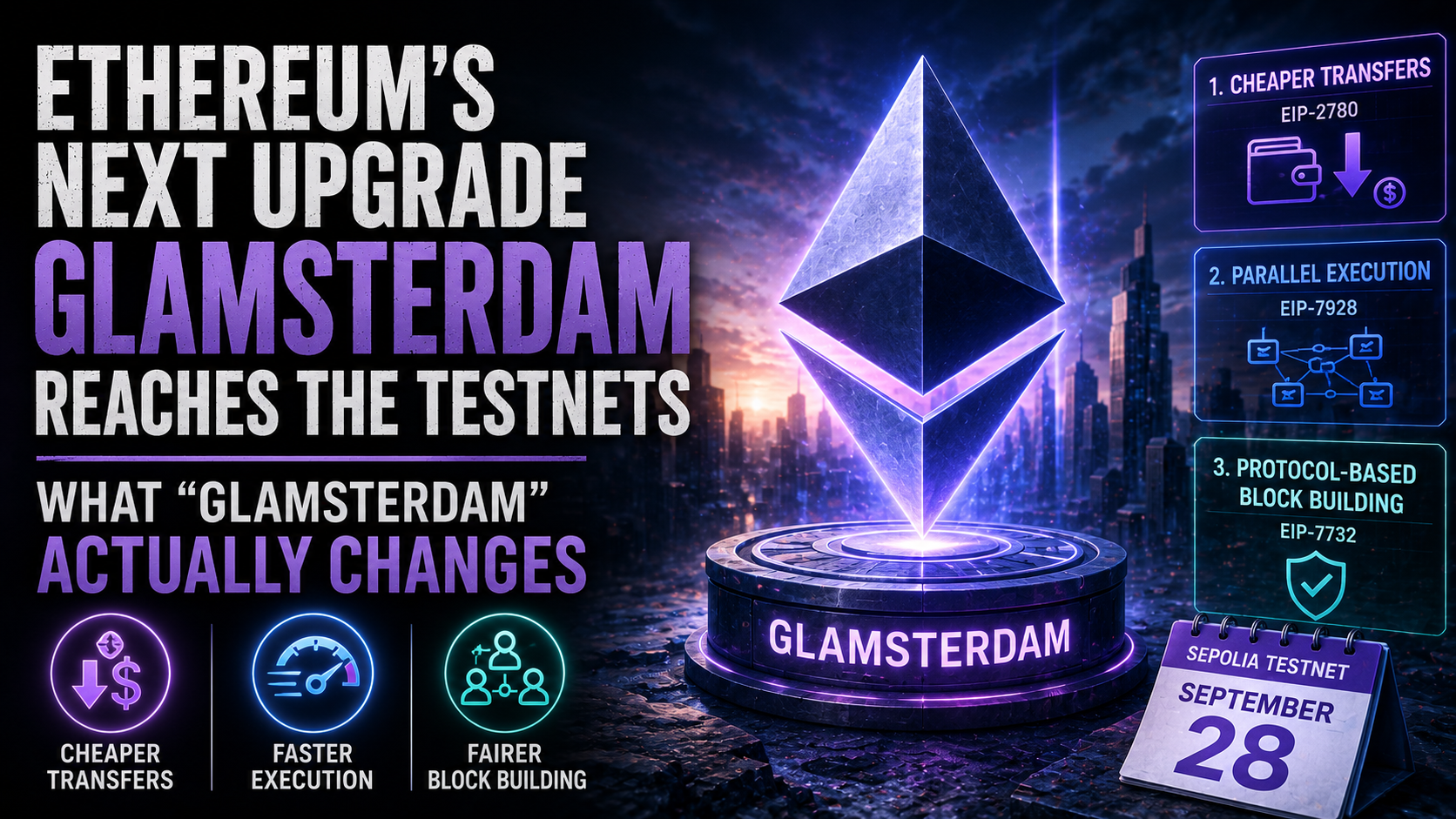
While the market watched interest rates and a Senate vote, Ethereum's developers quietly moved their next network upgrade toward release. Glamsterdam — a portmanteau of its two halves, the "Gloas" consensus change and the "Amsterdam" execution change — is scheduled to activate on the Sepolia test network around 28 September, with other testnets and then a mainnet date to follow if that goes cleanly.
Three things it aims to do
1. Make ordinary transfers cheaper. One change (EIP-2780) lowers the fixed "base cost" charged for the simplest kind of transaction — sending ETH from one normal account to another. The projected saving is large in percentage terms for those specific transfers; it does not change the cost of complex DeFi interactions.
2. Let the network process transactions in parallel. Today an Ethereum block is executed one transaction after another. Block-Level Access Lists (EIP-7928) require each transaction to declare up front which parts of state it touches, so non-overlapping transactions can be run at the same time. That raises the ceiling on how much a block can safely contain.
3. Move block-building into the protocol. "Enshrined proposer-builder separation" (EIP-7732) formalises a split that already happens informally: the validator that proposes a block and the specialist that assembles its contents become distinct roles defined by the protocol itself, rather than by private side-agreements. The goal is to reduce the influence a few large block-builders currently have.
Why it matters
None of this is a headline-grabbing narrative like "Ethereum goes proof-of-stake." But taken together it targets the two complaints that have followed Ethereum for years: that base-layer transactions are expensive, and that block production is quietly centralised. It also does the scaling work on layer 1 rather than pushing everything to rollups.
Upgrade timelines slip — this one has already been discussed for most of 2026 — so the Sepolia date is a milestone, not a guarantee. But it is the clearest signal yet that Glamsterdam ships this year.
What to watch
- Whether the 28 September Sepolia activation runs without a chain split or client bug.
- A firm mainnet date, which usually follows a few weeks after all testnets are done.
- How much the cheaper-transfer change actually shows up in real wallet costs after launch.
This article is general commentary for information only and is not investment advice.