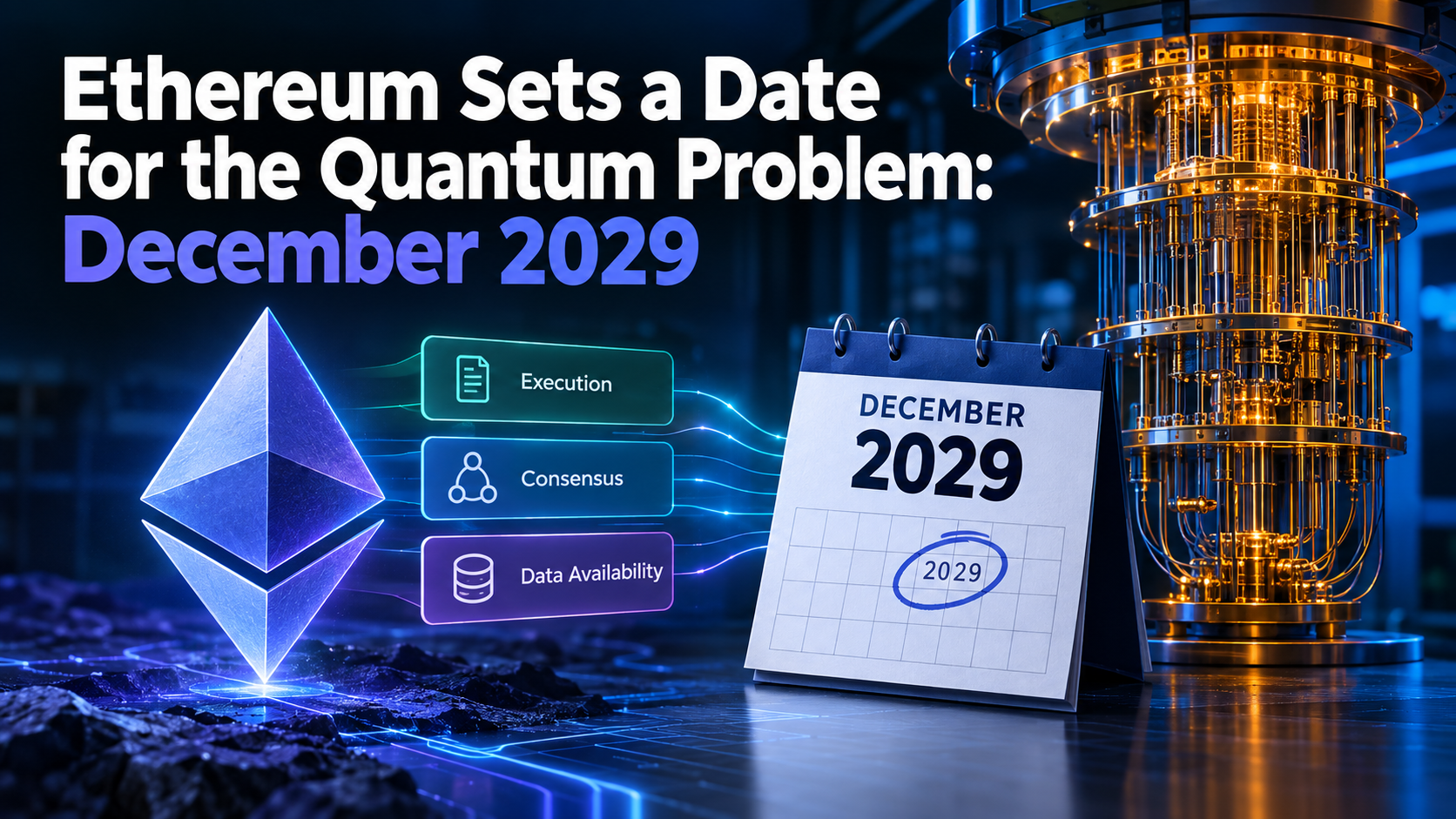
On 7 September, the group coordinating Ethereum's post-quantum work published a target: December 2029 for Ethereum Layer 1 to be quantum-resistant across all three of its core layers — execution, consensus and data availability. It follows a year of build-up: a dedicated Ethereum Foundation team formed in January, a public research hub, and more than ten client teams running weekly interoperability test networks.
Why now, when the computer doesn't exist
A quantum computer powerful enough to break the cryptography securing today's blockchains has not been built, and credible estimates for when one might arrive range from years to decades. The urgency is not about the machine — it is about "harvest now, decrypt later." An adversary can record encrypted data or public blockchain activity today and simply wait. The day a capable quantum computer exists, everything they stored becomes readable or forgeable retroactively. For a blockchain, where every public key and signature is permanently on-chain, that is a uniquely awkward exposure.
What actually has to change
Vitalik Buterin's roadmap breaks the problem into four separate pieces of cryptography, each needing its own quantum-safe replacement:
- Account signatures (currently ECDSA) — how your wallet proves a transaction is yours.
- Validator signatures (currently BLS) — how the thousands of validators agree on blocks.
- Data-availability commitments (currently KZG) — the maths that lets rollups post compressed data cheaply.
- Zero-knowledge proof systems — used for privacy and scaling.
Post-quantum replacements exist for all of these, but they are generally larger and slower, so the engineering challenge is swapping them in without making the network heavier to run.
Why it matters beyond Ethereum
Every major chain faces the same clock, and most have said far less about it publicly. Bitcoin's exposure is arguably narrower but its upgrade process is slower and more contentious. Ethereum putting a firm date on the table — even a soft one three years out — is partly a research milestone and partly a signal to the rest of the industry that this is now a scheduling problem, not a hypothetical.
For holders, nothing changes today. But "does this chain have a credible quantum plan?" is a reasonable question to start filing away, the same way oracle design and bridge security became standard things to check.
This article is general commentary for information only and is not investment advice.