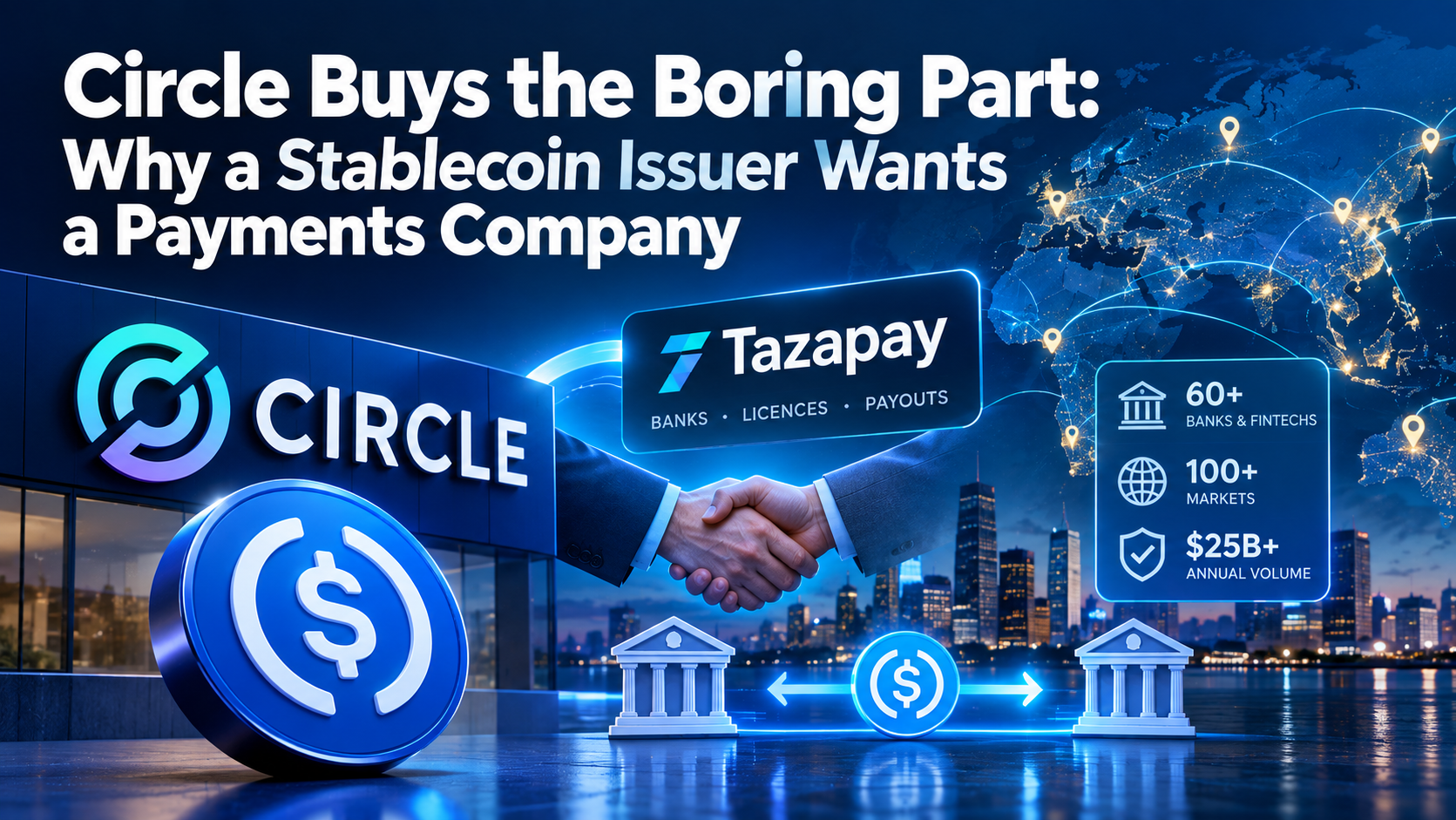
On 8 September, USDC issuer Circle agreed to buy Tazapay, a Singapore-based cross-border payments infrastructure company, for about $400 million in an all-stock deal. It is Circle's largest acquisition since 2018 and is expected to close in 2027, pending regulatory approval.
What Circle is actually buying
Tazapay is not a consumer brand. Its assets are connections: relationships with 60-plus banks and fintechs, licences and payout coverage in more than 100 markets, and the compliance work that sits behind each one. It processes over $25 billion a year, and the company says stablecoins already move most of that volume.
That "last mile" is the hard part of payments. Moving a digital dollar between two crypto wallets is trivial. Getting it into that system from a local bank account in one country, and back out to a local account in another — legally, at low cost, at scale — requires exactly the unglamorous licensing-and-banking footprint Tazapay spent years assembling.
Why a token issuer needs this
Circle makes most of its money from the interest earned on the reserves backing USDC. Growing that means getting more USDC into real-world use, especially for cross-border payments in Asia and emerging markets where sending money is slow and expensive. Owning the rails — rather than renting them from partners — lets Circle control the cost, the speed and the user experience end to end. It also makes USDC harder to dislodge once a business is plumbed into it.
The bigger pattern
This is the second time in two weeks Circle has signalled the same strategy: first a consumer-brand play (the Chelsea shirt deal), now the infrastructure underneath it. Competitors are moving similarly. The stablecoin race is quietly shifting from "who has the biggest token" to "who owns the most connections to the banking system" — which looks a lot less like crypto and a lot more like the payments industry it is trying to disrupt.
This article is general commentary for information only and is not investment advice.