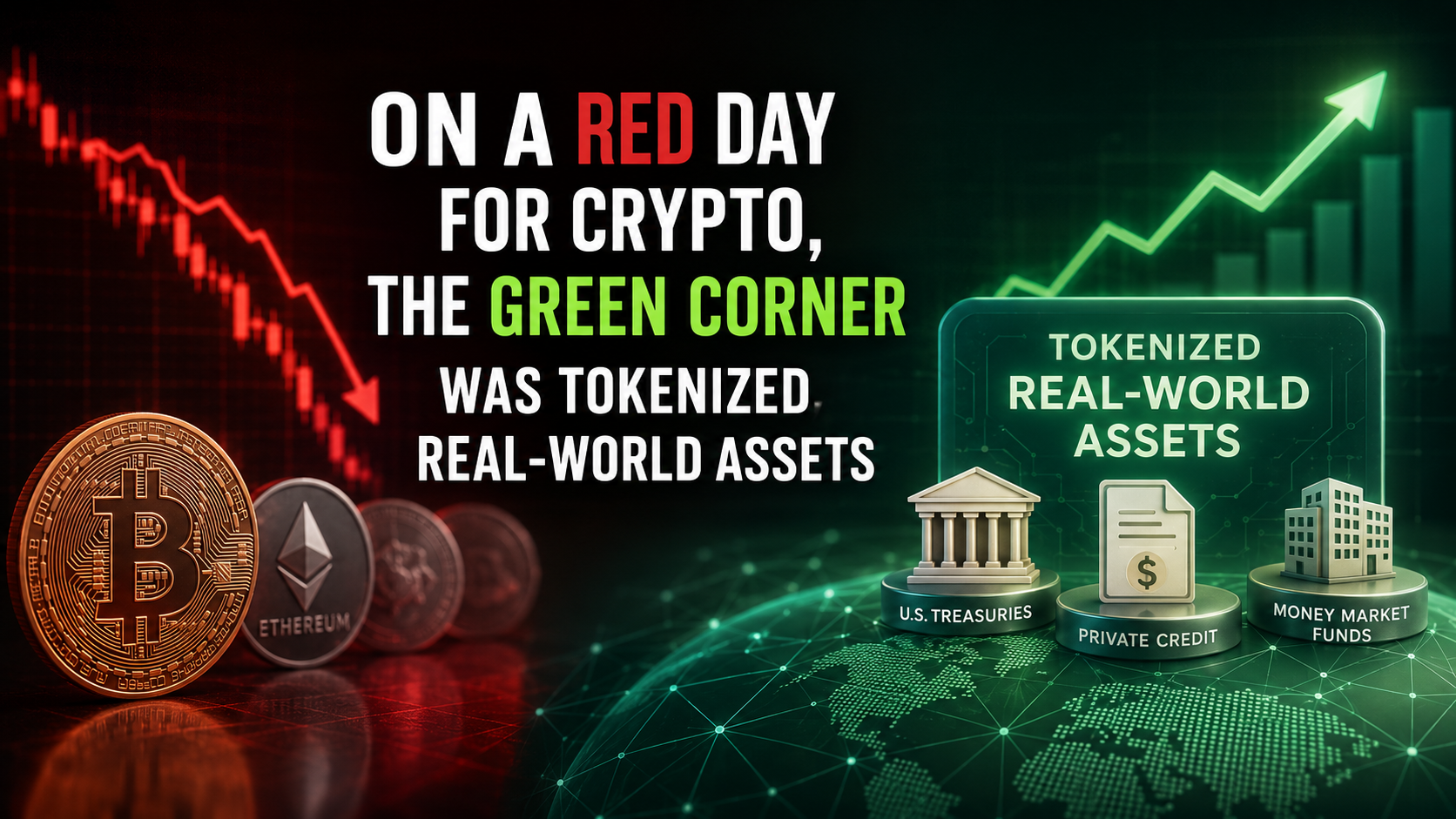
Friday, 29 August 2026 was a broadly negative session for crypto. The majors slipped, decentralised-finance tokens fell with them, and the market gave back part of its late-August rebound. Against that backdrop, one category stood out for going the other way: tokenized real-world assets, and specifically tokenized private credit.
What "real-world assets" means here
The term covers traditional financial instruments — government bonds, money-market funds, private credit, commodities, invoices — issued as tokens on a blockchain rather than tracked only in a bank's ledger. The pitch is straightforward: near-instant settlement, transferability around the clock, transparent holdings, and the ability to use the token as collateral inside other applications.
This is no longer a whiteboard idea. The on-chain RWA market has grown to roughly $32 billion, and it has expanded faster in 2026 than in any prior year. Short-term US Treasuries make up the largest slice, with private credit the fastest-growing one.
Why institutions are the ones pushing
Unusually for crypto, this trend is being driven from the top down. BlackRock's tokenized Treasury fund, launched in 2024, passed $2.8 billion in assets this summer. Other large asset managers have moved similar products from pilot phase into full production. For them the appeal is operational: fewer intermediaries, faster settlement cycles, and programmable compliance rules baked into the token itself.
Private credit is a natural early candidate. It is illiquid, hard to value, and slow to settle in its traditional form — exactly the pain points tokenization claims to ease by giving each loan a transparent, transferable representation.
The caveats
The infrastructure is still immature. Liquidity is fragmented across chains and issuers, secondary trading often depends on the issuer buying tokens back rather than an open market, and standards for interoperability and privacy are unsettled. A token is also only as sound as the asset and the legal structure behind it; on-chain packaging does not remove credit risk or counterparty risk.
The takeaway
Daily price moves get the headlines, but the migration of conventional assets onto public blockchains is the structural shift worth tracking. When a down day for crypto is also an up day for tokenized credit, it is a small sign that this segment is starting to trade on its own logic rather than moving in lockstep with Bitcoin.
This article is general commentary for information only and is not investment advice.